
Cycling Tips & Skills
Turbo for triathletes: Boost endurance, power and speed
As a triathlete, balancing swimming, running, and cycling requires well thought out training. When the weather doesn’t cooperate, or time
Designed for athletes travelling to train or compete, our triathlon travel insurance provides cover for medical treatment, trip disruption and event-related risks when triathlon is the main purpose of your trip — not incidental to a general holiday.
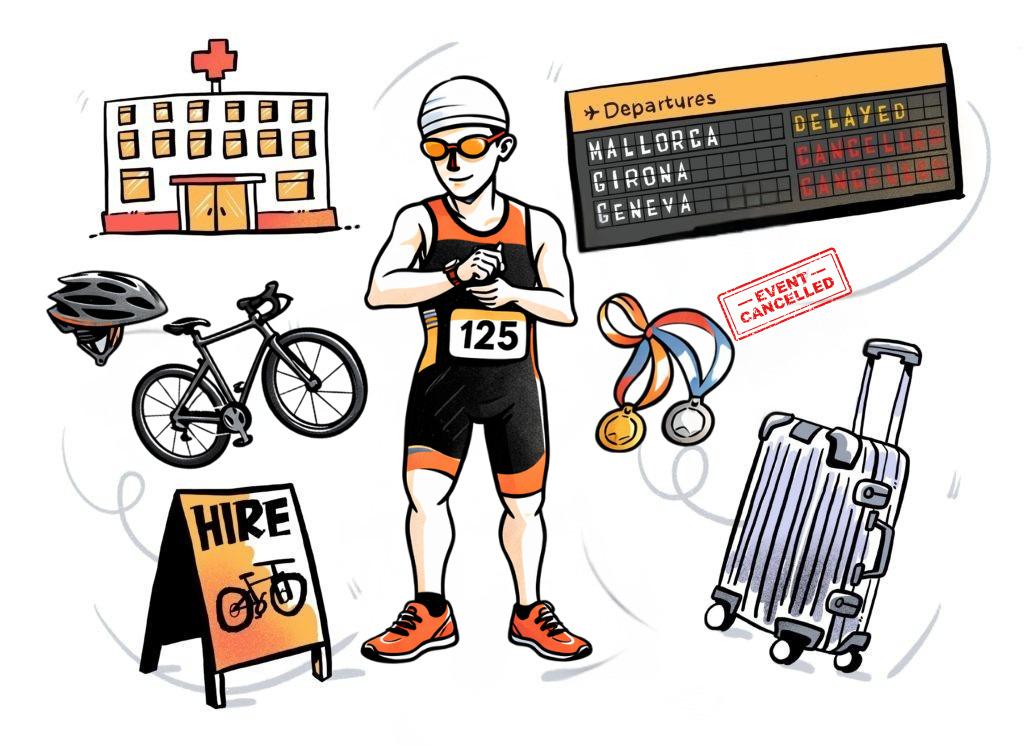



Built around the realities of travelling to train for or compete in triathlon events abroad, rather than treating sport participation as a minor add-on.
Select the appropriate activity pack depending on whether you’re training, competing, or taking part in organised or competitive triathlon events.
Protection for trip cancellation or curtailment if illness or injury prevents you from travelling or taking part in the triathlon activity your trip is based around.
Handled by people who understand triathlon incidents — backed by Pedal Cover.
Claims are handled by specialist travel claims partners who are trained and managed by Pedal Cover, with our team supporting you if something goes wrong.
Covering your bike itself
Cycle travel insurance protects you while you’re travelling and riding abroad.
Your bike is insured separately through Pedal Cover’s specialist cycle or home insurance — with flexible options depending on how much cover you need
Choose from bike-only cover or full home insurance, with rolling monthly options and no long-term commitment.
If you’re travelling primarily for triathlon training or racing, selecting the correct pack helps ensure your activity is covered in line with your policy terms.
Activities are grouped by riding type and risk level across Packs A–C, with clear definitions provided so you can be confident you’re selecting the activity that applies to your trip.
Entry-level cover for leisure riding and training trips
Non-competitive, casual cycling undertaken for sightseeing, transport, or general recreation, where cycling is not the primary purpose of the trip. Leisure Cycling excludes all activities defined under Packs A–C, including, for example, road cycling holidays, mass participation events, racing, triathlon, touring, etc.
Cycling on short, oval-shaped dirt tracks, typically around 70-90m in length. Riders compete on specially designed bikes with no gears, brakes, or suspension. Apart from while training, it usually involves racing four laps around the track, with riders competing in heats (individual or team-based) to score points.
Competitive cycling events that involve racing on a mixed terrain of grass, mud, dirt, and sometimes pavement, often on short, intense courses with obstacles that may mean participants have to dismount and carry their bikes. Cyclocross races usually take place on a closed course.
Road cycling activities where a large number of cyclists take part on predetermined routes. While a time of completion is provided, there is no winner. Examples include audax, sportives, charity rides and gran fondos. Road Racing and Criterium racing are not included.
Trips where the primary purpose is to undertake organised or self-directed recreational road cycling activities; this includes riding on public roads in scenic, challenging, or designated cycling environments, either individually, as part of a coached group or as a group of friends. These holidays do not involve participation in events or races. These trips can include tailored training, provided the activity is recreational and not undertaken for professional or semi-professional purposes.
Competitive cycling events where participants race individually against the clock over a set distance on roads. Time trials have cyclists starting at intervals rather than in a mass start. These events vary in distance, often ranging from short sprints to longer courses, and take place on closed or open roads.
Touring involves cycling on roads that covers distances up to (and including) 160km), with overnight stays in campsites, B&Bs, or hotels.
Bike packing involves a mixture of road and off-road cycling that covers distances up to (and including) 160km), with overnight stays at campsites or in the wild.
For both activities, your bicycle is your main mode of transport. You may visit no more than three countries in a single trip.
A type of cycling that takes place on unpaved roads, gravel paths, dirt trails, and other mixed surfaces that are less smooth than typical road cycling but not as technical as mountain biking. It combines elements of road biking and mountain biking, giving a versatile and adventurous riding experience.
Competitive events where athletes take part in a minimum of two of the following discipline completing the approximate distances:
swimming up to 1.5km
cycling up to 40km
running up to 10km
Races can take place on roads or on off-road terrain.
Specifically designed for triathletes to focus on training for any or all three of the triathlon disciplines — swimming, cycling, running. These holidays involve structured training sessions, coaching, and take place in locations with facilities such as open water swimming areas, cycling routes, and running trails. The goal is to improve endurance, technique and overall fitness in preparation for a triathlon race.
Off-road cycling using a mountain bike riding on varied terrains, such as trails through forests, hills, or mountain regions. It emphasises endurance and varied terrain and can include mountain bike orienteering but does not include highly technical or extreme downhill sections.
It also includes the use of “fat bikes” with oversized tires on soft surfaces, such as snow or sand, that enable cyclists to navigate terrains that standard mountain bikes cannot.
Riding on natural or man-made trails that can include both uphill and downhill sections, often with moderate technical features (but not downhill, enduro, freeride or dirt jumps).
Includes everything in Pack A, plus competitive and event riding
BMX pump track refers to cycling on dirt tracks with jumps, banked corners, and obstacles using BMX bikes. We do not cover BMX Freestyle (including street, park, vert, dirt, and flatland) an activity which involves performing tricks and stunts, often in skateparks or on flatland.
Track cycling refers to either competitive cycling events or cycle training held on specially designed indoor or outdoor tracks (velodromes), featuring banked curves and a smooth, enclosed surface. Track cycling races include various formats, such as sprints, pursuit races, points races, and madison races, where cyclists compete against each other in a controlled environment. Track cycling usually requires specialised bicycles with a fixed gear (the rear wheel is directly connected to the pedals) and a single gear ratio.
Touring involves cycling on roads that covers distances up to (and including) 160km), with overnight stays in campsites, B&Bs, or hotels.
Bike packing involves a mixture of road and off-road cycling that covers distances up to (and including) 160km, with overnight stays at campsites or in the wild.
For both activities, your bicycle is your main mode of transport. You can visit more than three countries in a single trip.
Road racing refers to competitive cycling events that take place on roads, where cyclists race against each other over a predetermined distance from one point to another. This includes single day events and stage races over multiple days. Road racing varies in distance and terrain, from flat courses to those with significant climbs and descents.
Criterium racing (often referred to as “crit racing”) is a form of competitive cycling that involves racing on a short, closed-loop course, usually in urban areas, purpose made cycle tracks, airfields and motor racing circuits. Criterium races are characterised by a series of laps over a relatively short distance, often ranging from 1 to 3km, and feature fast-paced riding with tight turns and frequent changes in speed. Races can involve large groups of cyclists competing at the same time.
Triathlon refers to competitive events where athletes take part in a minimum of two of the following disciplines: swimming, cycling, running. Races can take place on roads or on off-road terrain. ‘Ironman +’ refers to the approximate distance completed in each race: 3.6km swim, 180km cycle and 42km run or longer.
Triathlon multisport refers to competitive events where athletes participate in a minimum of two of the following disciplines: swimming, cycling, running. Races can take place on roads or on off-road terrain. ‘Up to Half iron’ refers to the approximate distance completed in each race: 1.9km swim, 90km cycle and 21km run.
Includes everything in Packs A and B, plus activities that involve increased speed, distance, terrain, altitude or technical difficulty.
Downhill mountain biking refers to descending on categorised routes only. Categories are based on the terrain, obstacles, steepness, and overall technicality of the routes with cyclists travelling at speed, possibly encountering drops and jumps. It usually requires finding another way to the top of the route, whether hiking, shuttling, or using a chairlift. 4X (Four-Cross) racing, is a type of downhill mountain biking.
Mountain bike trials riding is a specialised discipline of mountain biking where riders navigate through challenging obstacles including drops and gaps (both natural and man-made) without putting their feet on the ground. It focuses on balance, precision, and bike control, rather than speed.
Enduro (all-mountain) refers to a style of mountain biking that combines elements of downhill and cross-country riding. Enduro is also commonly associated with competitive events, typically consisting of multiple timed stages, often with uphill transfers between stages, where riders must complete downhill segments against the clock.
Freeriding involves performing tricks and stunts on natural or man-made features, such as jumps, drops, and obstacles. It often takes place in bike parks or specially designed trails.
Dirt jumping focuses on jumping over dirt ramps or mounds, with an emphasis on performing tricks in the air. It often takes place in dedicated dirt jump parks.
Ultra-endurance racing refers to non-stop cycling events that cover long distances over a period of several hours to several days. These races often require participants to ride continuously with minimal rest. Ultra-endurance cycling races can take place on roads, gravel, or off-road terrain, and can either be supported (with crew assistance) or unsupported (self-sufficient).
Ultra-endurance refers to cycling that covers distances over 160km. This often requires participants to ride continuously with minimal rest. Ultra-endurance can take place on roads, gravel, or off-road terrain, and can either be supported (with crew assistance) or unsupported (self-sufficient).
Mountain bike guided tours refer to organised cycling excursions led by professional guides through mountainous terrain at elevations above 3,500m but no higher than 5,500m.
Our triathlon travel insurance includes the essential protection you’d expect when travelling abroad — with additional protection designed around triathletes’ needs.
Below is a summary of what’s included. Full terms, conditions and limits are set out in the policy wording.
Covers emergency medical treatment if you’re injured or taken ill while travelling abroad, including injuries sustained while training for or competing in triathlon activities, in line with your selected activity pack.
This includes treatment arising from swimming, cycling, or running activities undertaken as part of a triathlon-focused trip, subject to policy terms and conditions.
Covers non-refundable travel and accommodation costs if you need to cancel or cut short your trip for an insured reason.
This includes situations where illness or injury prevents you from travelling or from taking part in the triathlon training or competition your trip is based around, subject to the policy terms.
If you’re seriously injured or unwell while abroad, repatriation cover helps get you back to the UK when medically necessary.
This includes emergency transport and medical escort arrangements where required, in line with medical advice.
Includes cover elements particularly relevant to triathlon-focused trips, where training or competition is the main purpose of travel.
This may include sport-related medical treatment and activity-specific cancellation scenarios, reflecting how triathlon training camps, races, and events are planned and undertaken abroad.
Provides personal liability cover if you’re held legally responsible for accidental injury to a third party or damage to their property while cycling abroad as part of a covered triathlon activity.
This applies while riding in accordance with the activities and conditions set out in the policy.
Choose between single-trip cover for a specific triathlon event or training camp, or annual multi-trip cover if you travel regularly for triathlon training or competition abroad.
Both options are available subject to policy terms, trip duration limits, and selected activities.
Covers loss, theft, or damage to personal belongings while travelling, including triathlon-related kit and equipment where applicable.
Policy limits and conditions apply, and high-value items must be declared in line with the policy wording.
Cover applies where triathlon activities are structured, organised, or competitive — including training camps, organised events, or races — provided the activity is listed within the appropriate activity pack.
This helps ensure your triathlon travel insurance remains valid when activities go beyond casual leisure participation.
We cover sports-related gadgets such as GPS watches, bike computers, and other high-value electrical items you take with you on your trip.
This can include devices commonly used for triathlon training and competition, subject to policy terms, limits, and the activities you’re undertaking.
| Benefit | Limit |
| Trip Cancellation | £5,000 |
| Medical Expenses / Repatriation (incl. heli-rescue if injured riding in the mountains) | £10mil |
| Dental Treatment | £250 |
| Hospital Benefit | £500 |
| Valuables | £5,000 |
| Travel Documents | £250 |
| Delayed Baggage | £250 |
| Personal Money | £500 |
| Travel Delay | £250 |
| Holiday Abandonment | £5,000 |
| Missed Departure | £1,000 |
| Loss of Limbs or Sight | £20,000 |
| Permanent Disablement | £20,000 |
| Death Benefit | £10,000 |
| Personal Liability | £2m |
| Emergency Cycle Hire | £500 |
| Race Fee Cancellation Cover | £500 |
| Cycle Breakdown Benefit | £200 |
| Cycle Repatriation Benefit | £250 |
| Gadget Cover | £2,000 |
| Ski Equipment | £350 |
| Ski Hire | £300 |
| Ski Pack | £200 |
| Piste Closure | £300 |
| Delay due to Avalanche | £300 |
Limits and benefits are designed to reflect triathlon bike-led travel, including training trips, events and riding abroad.
You can choose between single trip or annual multi-trip triathlon travel insurance depending on how often you plan to travel to train or compete abroad.
Single trip cover is designed for a specific triathlon event, race, or training camp.
Annual multi-trip cover can suit athletes who travel multiple times each year for triathlon training, races, or international events, without needing to arrange cover for each trip separately.
All options are subject to policy terms, trip duration limits, and selected activities.
Is triathlon racing covered under travel insurance?
Triathlon travel insurance is specialist travel insurance designed for trips where training for or competing in triathlon is the main purpose of travel. It reflects the risks associated with structured training and competition abroad, rather than treating sport as incidental.
Triathlon training camps may be covered where training activities are included within the selected activity pack, subject to policy terms.
Emergency medical expenses may be covered if you’re injured while training for triathlon abroad, provided the activity is included within your selected activity pack.
No. Triathlon travel insurance does not cover theft or damage to your bike. Protection for your bike is provided through a separate specialist
bicycle insurance.
Yes.
bicycle insurance
and triathlon travel insurance cover different risks.
Bicycle insurance
covers theft or damage to your bike, while travel insurance covers medical expenses, cancellation, and travel disruption when travelling abroad for triathlon.
Yes. You can select single-trip cover for a specific event or annual multi-trip cover if you travel regularly for triathlon training or races, subject to policy limits.
Specialist triathlon travel insurance is designed for athletes travelling to train or compete. It reflects the structure, planning, and risks of triathlon trips rather than relying on standard travel policies that may restrict or exclude organised sport.
As a triathlete, balancing swimming, running, and cycling requires well thought out training. When the weather doesn’t cooperate, or time
Pedal Cover is proud to announce a new partnership with Welsh Triathlon, marking an exciting step forward in our ongoing

Another long season done and dusted. Not sure about you, but I’ve done a fair bit of riding this year
Off season. A time for relaxing. Recovering. Enjoying the festivities. Off season. Cold. Wet. Long winter miles. Ah yes, the
0800 121 4424
Mon-Fri 9-5pm